When Is an Original Watch No Longer Original?
The curious world of service parts, replacement dials and the sometimes complicated relationship between authenticity, originality and value.
There are few words in the vintage watch world that carry quite as much weight as original.
Collectors look for it, dealers advertise it and buyers are often prepared to pay a considerable premium for it. But originality isn’t always as straightforward as it sounds. In fact, some of the most interesting watches we encounter occupy a rather awkward space between being entirely genuine and no longer being entirely original.
And, somewhat ironically, the manufacturer itself can sometimes be responsible.
The Rolex That Lost Its Flat 4
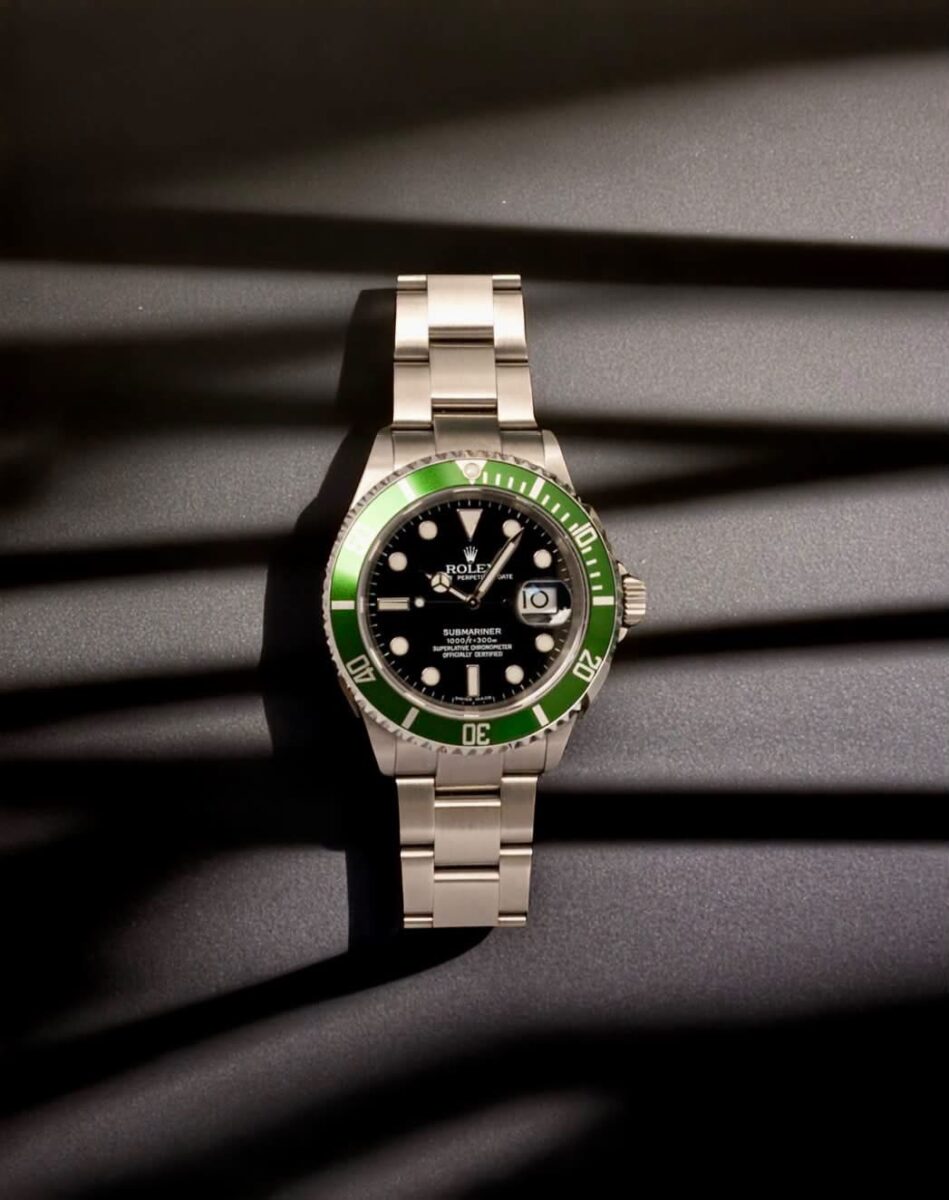
We currently (at the time of writing) have a particularly interesting Rolex Submariner Date 16610LV in stock.
Known affectionately as the Kermit, the 16610LV was introduced in 2003 to celebrate the Submariner’s 50th anniversary. Its green aluminium bezel insert and distinctive Maxi dial made it quite a departure from the familiar black Submariners that had come before.
Early examples featured what collectors now call the Flat 4 bezel insert, named after the distinctive flat-topped numeral four in the ‘40’ marking.
It’s a tiny detail, barely noticeable to most people, but one that has become particularly desirable among collectors.
Our example dates to February 2004, carries an F16-series serial number and had remained with its original owner from new until it found its way to Bramlys. Crucially, its history establishes that it had originally been supplied with a Flat 4 insert.
Then, in 2014, the owner sent it to Rolex for servicing.
Rolex did exactly what you would expect an authorised service centre to do. The watch was inspected, serviced and returned in proper working order. As part of that work, however, the original bezel insert was replaced with a later, non-Flat 4 version.
Ten years after leaving the factory, one of the watch’s most collectable features had disappeared.
Nothing counterfeit had been fitted. No independent watchmaker had made an unauthorised modification. The work had been carried out by Rolex itself, using a genuine Rolex component.
Yet the watch was no longer in its original configuration.
And that presents an interesting question: is it still a Flat 4 Kermit?
Historically, yes. It began life as one. But as it stands today, it no longer possesses the bezel insert that gives the variant its name.
That distinction matters, particularly when we start talking about value.
Genuine Doesn’t Necessarily Mean Original
One of the most common misconceptions in the pre-owned watch market is that genuine and original mean the same thing.
They don’t.
A watch can contain entirely genuine manufacturer-supplied parts and still differ considerably from its original factory specification.
Take a vintage Rolex Submariner that has received a replacement dial, hands and bezel insert during servicing. Every component might be authentic Rolex, the movement might be beautifully maintained and the watch might perform exactly as intended.
From a functional perspective, it could be a better watch than one that has spent the last forty years untouched.
But to a collector seeking an original example, it is a very different proposition.
This is where terminology becomes important.
An original dial is generally understood to be the dial fitted when the watch left the factory. A service dial is a genuine replacement supplied during subsequent maintenance. A period-correct dial may be appropriate for the watch’s age and reference, without necessarily being the one it originally left the factory with.
All three could be genuine.
Only one can confidently be described as original to that particular watch, assuming its history can actually be established.
It’s a distinction worth understanding before spending a significant amount of money.
When Maintenance Becomes a Modification
Manufacturers approach servicing primarily from the perspective of reliability, performance and appearance.
And quite reasonably so.
A watch arriving at a service centre with damaged hands, deteriorating luminous material or a badly faded bezel may be considered a candidate for replacement components.
The manufacturer wants to return a properly functioning watch that meets its servicing standards.
The collector, however, may see things rather differently.
That faded bezel could have developed a particularly attractive colour over several decades. The ageing luminous material might match perfectly across the dial and hands. Even minor imperfections can form part of what makes an individual watch interesting.
Replacing those components may make the watch look newer, but it can also erase some of the characteristics that made it desirable in the first place.
Of course, not every deteriorated component should be preserved at any cost. Flaking dial material, damaged seals and compromised movement components can create genuine mechanical problems.
There is a sensible distinction between preserving originality and allowing a watch to deteriorate.
The difficulty is knowing where to draw that line.
The Difference Between Ageing and Damage
Collectors have developed an extraordinary vocabulary to describe what happens to watches over time.
We talk about tropical dials, ghost bezels, creamy lume and attractive patina.
Occasionally, these descriptions make ordinary deterioration sound rather more romantic than it deserves.
But there is a legitimate reason why certain forms of ageing are valued.
A naturally faded bezel, for example, can provide evidence of the watch’s history and produce an appearance that cannot be replicated convincingly simply by fitting a new component.
Likewise, the colour of the luminous material on a vintage dial and its hands can contribute significantly to the character of a watch.
But ageing alone doesn’t automatically make something desirable.
A badly water-damaged dial isn’t necessarily attractive patina. Corrosion isn’t a charming sign of authenticity. And a heavily degraded component doesn’t become valuable simply because nobody has replaced it.
Originality and condition are two separate considerations, and the most desirable watches usually offer a convincing balance of both.
It’s also worth remembering that patina can be manufactured, accelerated or artificially enhanced. An attractive appearance should never replace careful examination of the actual components.
What About Replacement Parts from the Correct Period?
This is where things become particularly complicated.
Imagine a vintage Rolex GMT-Master that has had its original bezel insert replaced with another genuine Rolex insert from the same period.
The replacement may be entirely correct for the reference. It may have aged beautifully and look indistinguishable from an insert that has been fitted since new.
But is the watch original?
Strictly speaking, not in that respect.
It’s period-correct, but not original to the watch.
And unless reliable documentation or historical photographs exist, it may be impossible to establish when that particular component was fitted.
This uncertainty is part of the reality of collecting watches that may have passed through several owners and numerous watchmakers over half a century.
It is also why absolute claims of originality should be treated with a degree of caution.
An experienced dealer can assess whether a dial, handset or bezel is correct for a particular reference and production period. What they cannot always establish is whether those exact components were fitted at the factory.
There is a meaningful difference between the two.
The Financial Consequences
Returning to our 16610LV Kermit, the market illustrates this distinction rather neatly.
At the time we offered it for sale, our one-owner February 2004 example was priced at £12,995.
Comparable Flat 4 examples advertised in the UK were starting at approximately £17,995.
That is a substantial difference for two watches sharing the same reference, movement, case design and fundamental appearance.
Of course, advertised prices are not necessarily achieved selling prices, and factors such as condition, documentation, production details and originality all influence value.
Nevertheless, the contrast demonstrates just how much significance collectors can attach to a relatively small component.
A bezel insert that Rolex considered perfectly reasonable to replace during servicing had become an important factor in the watch’s collectability.
It is difficult to imagine the original owner, taking the watch in for routine maintenance in 2014, anticipating that consequence.
There is something rather extraordinary about that.
Should You Ever Replace Original Parts?
Our view is that the answer depends on the watch, the component and the reason for replacing it.
We certainly wouldn’t suggest avoiding necessary mechanical maintenance simply to preserve originality.
A properly serviced movement, with worn internal components replaced where required, is generally preferable to one that is gradually damaging itself through neglect.
But cosmetic components deserve more consideration, particularly on watches with recognised collector significance.
Before authorising the replacement of a dial, hands, bezel insert or other visually important component, it is worth establishing whether the work is necessary and what effect it might have on the watch’s desirability.
It is also worth asking whether the original parts can be retained and returned. Manufacturer policies vary, and this isn’t always possible, but the question should be raised before the work is carried out.
Not every watch needs to be preserved as a museum piece. Many owners simply want a reliable, attractive watch that they can enjoy wearing.
There is absolutely nothing wrong with that.
The important thing is understanding the implications of the choices being made.
Buy the Watch … but Understand Its History
One of the things we enjoy most about dealing in pre-owned watches is that two apparently identical references can have remarkably different stories.
One may be completely untouched, another carefully maintained using genuine replacement components, and a third sympathetically restored after decades of wear.
None is automatically the wrong watch to buy.
What matters is that its condition, specification and history are properly understood and reflected in the price.
Personally, we would rather see a watch accurately described with replacement components than one presented as completely original when its history cannot support that claim.
There is nothing inherently wrong with a Rolex service dial, replacement hands or a later bezel insert. Problems arise when those details are overlooked, misunderstood or deliberately left out of the conversation.
And perhaps that’s the most important distinction of all.
Originality is not the same as authenticity. Authenticity is not the same as condition. And none of those things, considered in isolation, necessarily tells you whether a watch is worth buying.
Our Kermit is a particularly good illustration.
It remains a lovely, genuine, one-owner Rolex Submariner with an interesting and documented history. It simply happens to have lost a small part of its original identity during an entirely legitimate service.
Does that make it a less interesting watch?
We’d argue quite the opposite.
It just makes it a different proposition from an untouched Flat 4, and one that deserves to be understood on its own merits.
After all, not every good watch needs to be a perfect collector’s specimen. But every buyer deserves to know exactly what they’re looking at.
Gallery not found.
Author: Bramlys