Inside the Audemars Piguet Royal Oak Concept CW1: Engineering the Future in 2002
The Audemars Piguet Royal Oak Concept CW1 25980AI.OO.D003SU.01 occupies a unique place in modern watchmaking. Today, it is easy to take exotic materials, visible mechanics and futuristic architecture for granted, but in 2002 virtually none of these ideas existed together in a serially produced luxury sports watch. The CW1 was not designed to be a commercial success – it was conceived as a technological manifesto.
It represented the first time that Audemars Piguet allowed its engineering division, working alongside APRP (Audemars Piguet Renaud & Papi), to build a watch almost entirely free from conventional constraints. The project sought to answer a simple question:
“If we designed the Royal Oak from scratch using every technology available in 2002, what would it become?”
The answer became the Royal Oak Concept.
Historical Context
The original Royal Oak, designed by Gérald Genta, debuted in 1972. By 2002 it had become one of the world’s defining luxury sports watches but AP recognised that merely issuing another anniversary edition would do little to demonstrate the company’s technical capabilities.
Instead, they celebrated the model’s 30th anniversary by creating something almost deliberately shocking.
Rather than refining the existing Royal Oak, almost every component was reconsidered:
- completely new movement
- completely new case material
- completely new case construction
- new shock protection systems
- entirely new dial architecture
- visible movement mechanics
- experimental displays
Nothing quite like it had ever come from a traditional Swiss manufacturer.
In hindsight, it was arguably the birth of modern “technical haute horlogerie”, paving the way for many of today’s highly architectural watches.
Case Construction
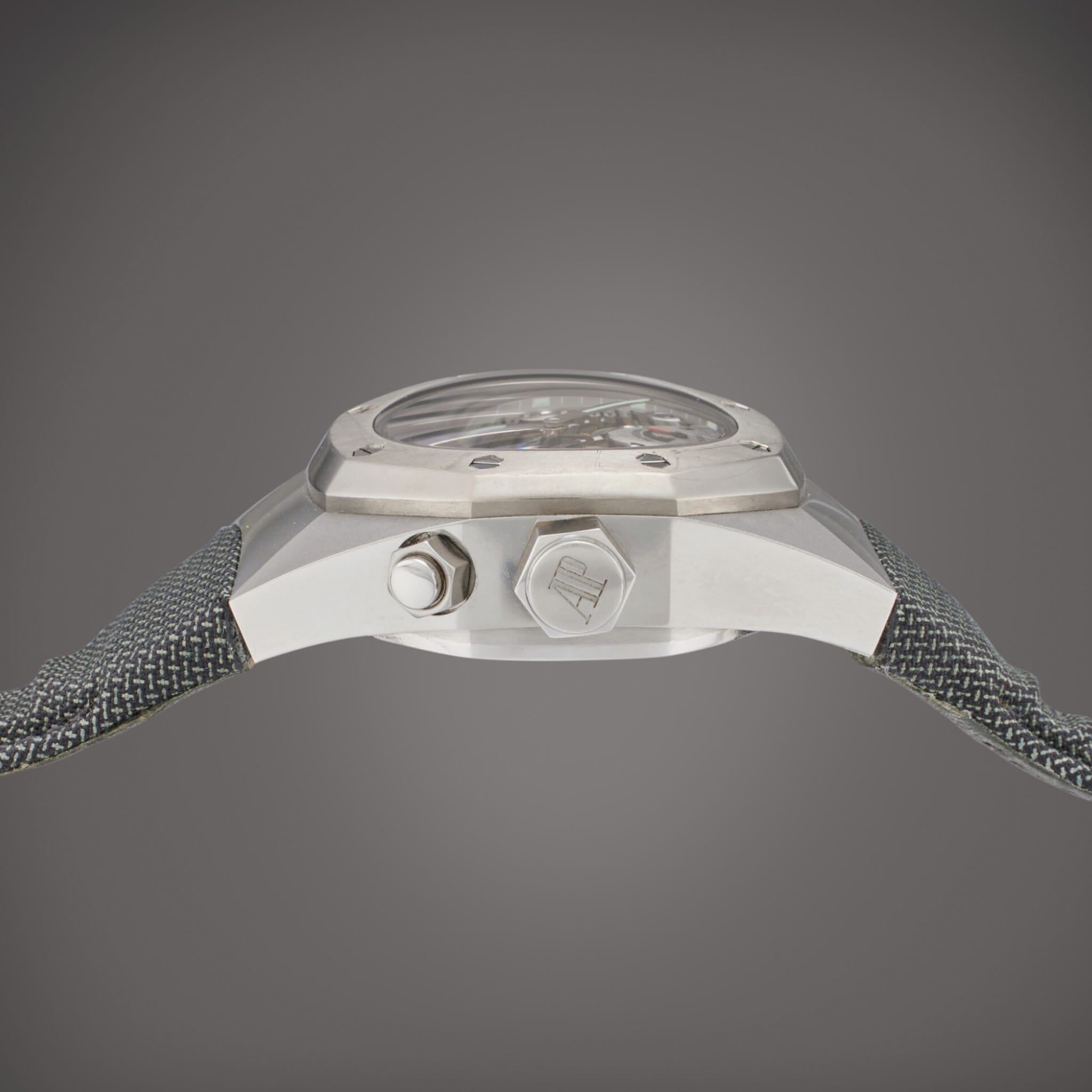
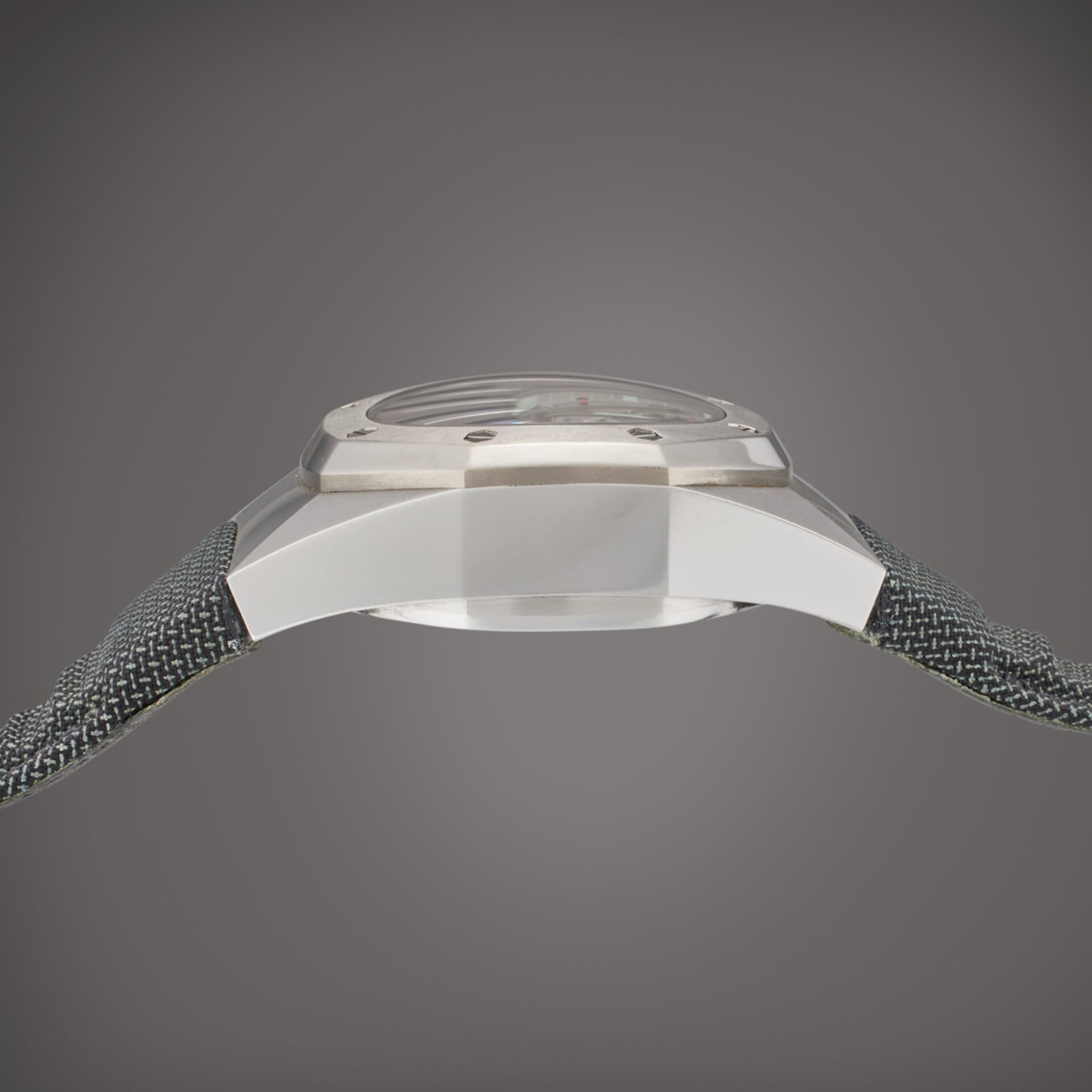
Alacrite 602
Perhaps the most fascinating aspect of the CW1 is its case material.
Instead of steel, titanium or gold, AP chose Alacrite 602, a cobalt-chromium alloy originally developed for:
- aerospace turbines
- medical implants
- jet engine components
- high-stress engineering
At the time virtually nobody had attempted machining this material into a watch case.
Mechanical properties
Compared with 316L stainless steel:
- significantly harder
- considerably more scratch resistant
- exceptional corrosion resistance
- extremely stable dimensionally
- resistant to fatigue
- biocompatible
Its hardness also made it exceptionally difficult to finish.
Unlike titanium, which is relatively soft to polish, Alacrite required specialist tooling simply to create the alternating brushed and polished Royal Oak surfaces.
Many collectors underestimate how revolutionary this was in 2002.
Dimensions
- Diameter: 44mm
- Thickness: approximately 15.7mm
- Water resistance: 100 metres
Although 44mm sounds enormous for 2002, the sharply faceted case and integrated strap allow it to wear surprisingly comfortably.
Its angular architecture also makes it appear more like an engineering instrument than jewellery.
The Movement – Calibre 2896
The movement was developed by APRP specifically for the Concept.
Basic specifications
- Manual winding
- Calibre 2896
- 70-hour power reserve
- 21,600 vibrations per hour (3Hz)
- Tourbillon escapement
- Approximately 380 components
- Hand finished throughout
Unlike traditional AP calibres hidden beneath a dial, virtually every bridge was designed as part of the watch’s visual identity.
The movement itself effectively becomes the dial.
Suspension System
One of the least discussed innovations is the movement mounting.
Traditional movements are rigidly fixed inside the case.
The CW1 instead uses an elaborate shock absorption architecture, allowing the movement to better resist impacts.
Because the tourbillon carriage is particularly vulnerable to shocks, AP engineered flexible mounting points intended to isolate the movement from sudden impacts transmitted through the case.
Although modern Concept watches have evolved this idea considerably, the CW1 laid the foundation.
Tourbillon
The one-minute tourbillon occupies the left side of the dial.
Unlike classical tourbillons hidden beneath elegant bridges, this one is deliberately exposed.
Its architecture emphasises:
- polished steel components
- hand bevelled edges
- lightweight construction
- visual depth
The objective wasn’t simply accuracy.
It was to demonstrate movement architecture as industrial art.
Dynamograph (Torque Indicator)
Perhaps the CW1’s greatest technical achievement is the Dynamograph.
Many publications incorrectly describe this as a power reserve.
It isn’t.
Instead, it measures mainspring torque.
That distinction is extremely important.
Why torque matters
As a mainspring unwinds, two things happen:
- The amount of stored energy decreases.
- More importantly, the force delivered to the escapement changes.
Chronometric performance is best when torque remains within a certain operating window.
The Dynamograph allows the wearer to monitor exactly where the movement sits within that window.
The display indicates:
- Green → optimum operating torque
- Yellow → acceptable
- Red → outside optimum efficiency
This gives the owner information about expected precision rather than simply remaining running time.
Even today, torque indicators remain exceptionally rare.
Power Reserve
The separate 70-hour power reserve display shows the amount of stored energy remaining.
Unlike the Dynamograph, this is simply measuring spring tension.
Having both indicators together allows the wearer to distinguish between:
- how much energy remains
- how efficiently that energy is being delivered
That distinction was almost unheard of in wristwatches.
Linear Display Layout
One reason the CW1 still feels contemporary is its layout.
Instead of organising indications around a central dial, AP arranged them vertically:
- torque indicator
- power reserve
- exposed gear train
- tourbillon
This “machine” aesthetic influenced countless later Concept models.
Today it appears familiar.
In 2002 it looked like science fiction.
Finishing
Although highly technical, the watch remains classic haute horlogerie.
Every bridge receives:
- hand bevelled anglage
- polished countersinks
- satin brushing
- mirror polished steel components
- Geneva-style decorative finishing where appropriate
The finishing deliberately contrasts traditional craftsmanship with futuristic engineering.
Strap System
The integrated rubber strap was another forward-thinking feature.
Luxury sports watches had used rubber before, but rarely in such an integrated manner.
Its sculpted profile flows directly from the case without conventional lugs, reinforcing the watch’s monolithic appearance.
Influence on Future Watchmaking
The CW1’s importance is difficult to overstate.
Without it, many later AP innovations might never have existed.
It directly influenced:
- the entire Royal Oak Concept collection
- forged carbon Royal Oaks
- Concept GMT Tourbillon
- Concept Supersonnerie
- Concept Flying Tourbillons
- Concept Split-Seconds Chronographs
- Concept Black Panther and Spider-Man collaborations
Its broader influence can also be seen across the industry. The idea of treating a movement as an architectural display rather than something hidden beneath a dial became increasingly common in the years that followed, influencing everything from avant-garde independents to high-end sports watches from competing maisons.
Collectability
Only 150 examples of the CW1 were produced, making it one of the rarest Royal Oak Concepts. It appeals to collectors not because it is merely scarce, but because it marks the beginning of an entirely new chapter for Audemars Piguet.
Unlike many limited editions, the CW1 was never intended to commemorate the past. Instead, it was built to preview the future – and remarkably, more than twenty years later, its bold design language, unconventional materials and technical solutions still feel contemporary. It remains one of the clearest demonstrations of Audemars Piguet’s philosophy that innovation and traditional hand craftsmanship can co-exist in a single watch.


Author: Bramlys