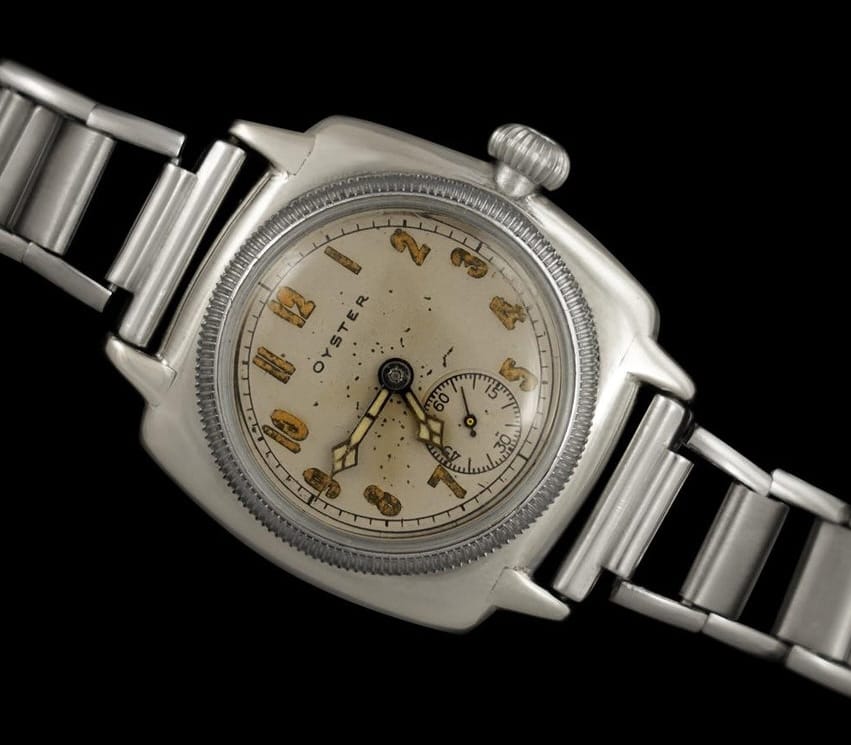
For over a century, wristwatches have battled the same enemies: water, dust, humidity and the harsh realities of daily life. Today, we take water resistance for granted. Dive watches can descend hundreds, if not thousands, of metres underwater, sports watches survive mountain expeditions and even dress watches offer levels of protection unimaginable a century ago.
But before 1926, watches were fragile … very fragile.
Moisture could seep through cases with ease, dust would slowly damage movements internally and even everyday exposure to rain or perspiration could become a genuine concern for owners. Wristwatches themselves were still fighting for legitimacy, with many people viewing them as delicate jewellery rather than serious timekeeping instruments.
That all changed when Rolex introduced one of the most important developments in horological history: The Rolex Oyster Case.
It wasn’t simply a new watch case. It fundamentally changed what a wristwatch could be.
Before The Oyster: Watches Weren’t Built For Everyday Life
To understand the significance of the Oyster Case, you first need to understand the state of watchmaking in the early 20th century.
Pocket watches had dominated for decades and while wristwatches began growing in popularity following World War I, durability remained a major issue. Cases were often snapped shut rather than fully sealed, crowns allowed moisture into movements and dust intrusion was a constant problem.
In short, watches were vulnerable.
For many people, this meant owning a watch required caution. Rainstorms, swimming, humidity and physical activity all posed real risks. A wristwatch was not yet considered a true “tool”.
Hans Wilsdorf, the founder of Rolex, believed this needed to change.
His vision was simple but ambitious: Create a watch robust enough for modern life.
The Birth Of The Rolex Oyster Case
In 1926, Rolex unveiled the Oyster — the world’s first commercially successful waterproof wristwatch case.
The name itself was deliberate. Much like an oyster shell protects what lies inside, the Oyster Case was designed to shield the movement from the outside world.
The innovation centred around three key components:
- A screw-down bezel
- A screw-down caseback
- A screw-down winding crown
Combined, these elements created a hermetically sealed case far more resistant to water and dust than anything that had come before.
Today, screw-down crowns are completely normal. In 1926, they were revolutionary.
The Oyster Case marked the moment watches began transitioning from delicate accessories into dependable companions capable of handling everyday wear.
The Mercedes Gleitze Story: Rolex’s Masterstroke
Creating a waterproof watch was one thing.
Convincing the world it actually worked was another.
Rolex’s most famous early marketing triumph came in 1927 when British swimmer Mercedes Gleitze attempted to swim across the English Channel.
Around her neck during the swim was a Rolex Oyster.
After more than 10 hours in cold water, the watch reportedly emerged still functioning perfectly.
Whether viewed as brilliant marketing, genuine innovation, or both, the story became legendary.
Rolex placed full-page newspaper advertisements celebrating the achievement, helping establish the Oyster not merely as a watch, but as a technological breakthrough.
It was one of the earliest examples of modern luxury sports watch marketing — something Rolex would later master better than perhaps any brand in history.
Why The Oyster Case Was So Important
The Oyster didn’t just improve Rolex.
It changed expectations across the entire watch industry.
For the first time, consumers began expecting wristwatches to survive real life. Waterproofing became desirable, then necessary and eventually standard across serious watchmaking.
Without the Oyster Case, many categories of watches we now take for granted may never have existed in the same way:
- Dive watches
- Sports watches
- Military watches
- Adventure watches
- Professional tool watches
The Oyster laid the foundation for all of them.
Its importance cannot be overstated.
The Evolution Of The Oyster Case
While the original 1926 Oyster was groundbreaking, Rolex never stopped refining the concept.
Over the decades, the Oyster Case evolved significantly:
- Improved crown sealing systems
- Stronger metallurgy
- Better machining tolerances
- Increased depth ratings
- Enhanced corrosion resistance
- More robust sapphire crystals
Modern Rolex Oyster cases are engineered to extraordinarily high standards, combining durability, water resistance and precision manufacturing in a way few brands can truly replicate at scale.
Today, even many entry-level Rolex Oyster models offer 100 metres of water resistance — something almost unimaginable in the 1920s.
The Most Important Oyster Watches Ever Made
The Oyster Case became the foundation for some of the most iconic watches ever created.
Rolex Submariner
Perhaps the ultimate Oyster evolution. Introduced in 1953, the Submariner helped define the modern dive watch and became one of the most recognisable watches in history.
Rolex Datejust
Released in 1945, the Datejust combined Oyster durability with everyday elegance and introduced the now-famous date complication at 3 o’clock.
Rolex Explorer
Built around the idea of rugged exploration, the Explorer embodied the Oyster philosophy perfectly.
Rolex GMT-Master
Originally designed for pilots, the GMT-Master demonstrated how the Oyster platform could evolve into specialist professional tools.
Rolex Daytona
Now one of the world’s most desirable watches, the Daytona showed the Oyster Case could support high-performance chronograph movements while maintaining robustness and water resistance.
The Oyster And The Birth Of Luxury Sports Watches
One of the most fascinating aspects of the Oyster is how it blurred the line between utility and luxury.
Prior to this era, “luxury” and “robustness” rarely existed together in watchmaking.
The Oyster helped create a completely new category:
The luxury sports watch.
Rolex proved a watch could be:
- Elegant
- Precise
- Waterproof
- Durable
- Prestigious
That formula became one of the most influential ideas in modern horology.
Today, countless brands still follow the blueprint Rolex established nearly 100 years ago.
Vintage Oyster Watches: Why Collectors Love Them
Collectors remain deeply fascinated by vintage Oyster watches for several reasons.
Historical Importance
Early Oyster references represent major milestones in watchmaking history.
Patina
Tropical dials, faded bezels, creamy lume and aged cases give vintage Oyster models unique personalities impossible to recreate artificially.
Simplicity
Many enthusiasts appreciate the clean proportions and understated charm of earlier Oyster references.
Neo-Vintage Appeal
Five-digit Rolex models from the late 1980s through early 2000s have become especially collectible, offering a balance between vintage character and modern wearability.
For many collectors, these watches represent the sweet spot of Rolex design.
How Modern Oyster Cases Compare
Modern Rolex Oyster cases are vastly more sophisticated than their early counterparts.
Current production models feature:
- CNC-machined cases
- Advanced Oystersteel alloys
- Triplock and Twinlock crown systems
- Sapphire crystals
- Exceptional manufacturing tolerances
Yet despite all the advancements, the philosophy remains remarkably similar to the original 1926 concept:
Protect the movement at all costs.
That continuity is part of what makes Rolex so compelling as a brand.
Why The Oyster Still Matters Nearly 100 Years Later
Very few innovations in watchmaking remain relevant a century later.
The Oyster Case does.
It didn’t merely improve watches — it redefined them.
Even today, when collectors discuss Rolex, much of the brand’s identity still revolves around the values first established by the Oyster:
- Reliability
- Robustness
- Everyday practicality
- Precision engineering
- Timeless design
In many ways, the modern luxury watch industry still lives in the shadow of the Oyster Case.
Final Thoughts
The Rolex Oyster Case was more than a technical innovation.
It was the moment wristwatches truly became modern.
From English Channel swims to deep-sea exploration, mountain expeditions to everyday wear, the Oyster fundamentally changed how people interacted with watches. It turned them from delicate objects into dependable tools — and eventually, enduring symbols of achievement and style.
Nearly 100 years later, its influence can still be seen everywhere.
Very few watch designs can genuinely claim to have changed the industry forever.
The Oyster Case is unquestionably one of them.